
100 Most Common Vietnamese Words (with Typing Drills)
If you learn the 100 most common words of a language, you can understand a surprising amount of everything you hear. Vietnamese is no exception: the words on this page do the heavy lifting in almost every sentence — the pronouns, the everyday verbs, the little words that hold sentences together. Learn them, and you will recognise them in every menu, every conversation and every song.
Each word comes with its meaning and its Telex keystrokes, so you can learn to type it as you learn it. Learn ten words a day and you will know all 100 in ten days; type each one as you learn it and your fingers will know them too. If Telex is new to you, read our complete Telex guide first. For the numbers and time words in this list, see our guide to Vietnamese numbers and our guide to days, months and telling the time.
How to use this list
Do not try to memorise all 100 words in one sitting. Work through one group a day, say each word out loud, and type it three times in our free typing trainer. The words are grouped by what they do in a sentence, and the groups are ordered the way a beginner needs them: people first, then actions, then things, then descriptions, then the little connecting words, then time.
🎮 Play Vietnamese Games — free
One warning before you start: Vietnamese words change meaning with context. Đường is “road” and also “sugar”. Nước is “water” and also “country”. Hay is “or” and also “good” or “interesting”. The meaning given here is the most common one — the one you will meet first.
1. People and pronouns (17 words)
Vietnamese pronouns are family words — you choose them by age and relationship, not by grammar. Our guide to Vietnamese pronouns explains the whole system; this table gives you the words themselves.
| # | Vietnamese | Meaning | Type (Telex) |
|---|---|---|---|
| 1 | tôi | I, me (neutral) | tooi |
| 2 | bạn | you; friend | banj |
| 3 | anh | older brother; “you” to an older man | anh |
| 4 | chị | older sister; “you” to an older woman | chij |
| 5 | em | younger sibling; “you” to a younger person | em |
| 6 | mình | I (intimate); oneself | minfh |
| 7 | họ | they | hoj |
| 8 | cô | aunt; “you” to a woman of your mother’s age | coo |
| 9 | chú | uncle; “you” to a man of your father’s age | chus |
| 10 | bác | older uncle/aunt; “you” to an older person | basc |
| 11 | ông | grandfather; “you” to an elderly man | oong |
| 12 | bà | grandmother; “you” to an elderly woman | baf |
| 13 | mẹ | mother, mum | mej |
| 14 | cha | father (formal, literary) | cha |
| 15 | bố | father, dad | boos |
| 16 | con | child; son, daughter | con |
| 17 | người | person, people | nguowif |
2. Everyday verbs (20 words)
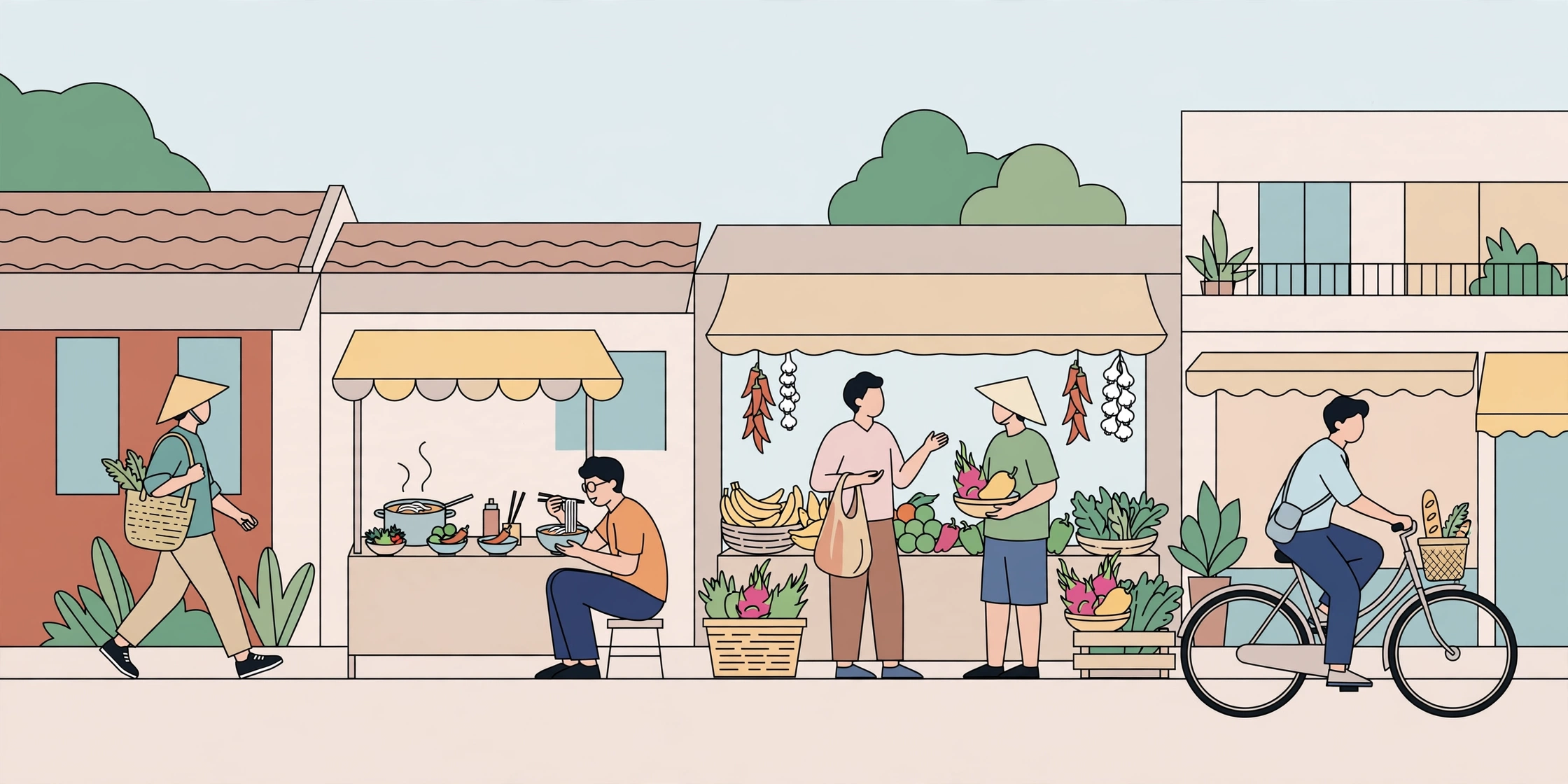
These twenty verbs build most of the sentences a beginner needs: to be, to have, to go, to eat, to know, to want. Learn them first and the rest of the language starts to open up.
| # | Vietnamese | Meaning | Type (Telex) |
|---|---|---|---|
| 18 | là | to be | laf |
| 19 | có | to have; there is | cos |
| 20 | đi | to go | ddi |
| 21 | đến | to arrive; to come | ddeesn |
| 22 | về | to return; to go home | veef |
| 23 | làm | to do; to make | lamf |
| 24 | nói | to say; to speak | nois |
| 25 | biết | to know | bieest |
| 26 | muốn | to want | muoosn |
| 27 | cần | to need | caanf |
| 28 | ăn | to eat | awn |
| 29 | uống | to drink | uoosng |
| 30 | ngủ | to sleep | ngur |
| 31 | xem | to watch; to look at | xem |
| 32 | nghe | to listen; to hear | nghe |
| 33 | đọc | to read | ddojc |
| 34 | viết | to write | vieest |
| 35 | học | to learn; to study | hojc |
| 36 | chơi | to play | chowi |
| 37 | mua | to buy | mua |
3. Everyday nouns (19 words)
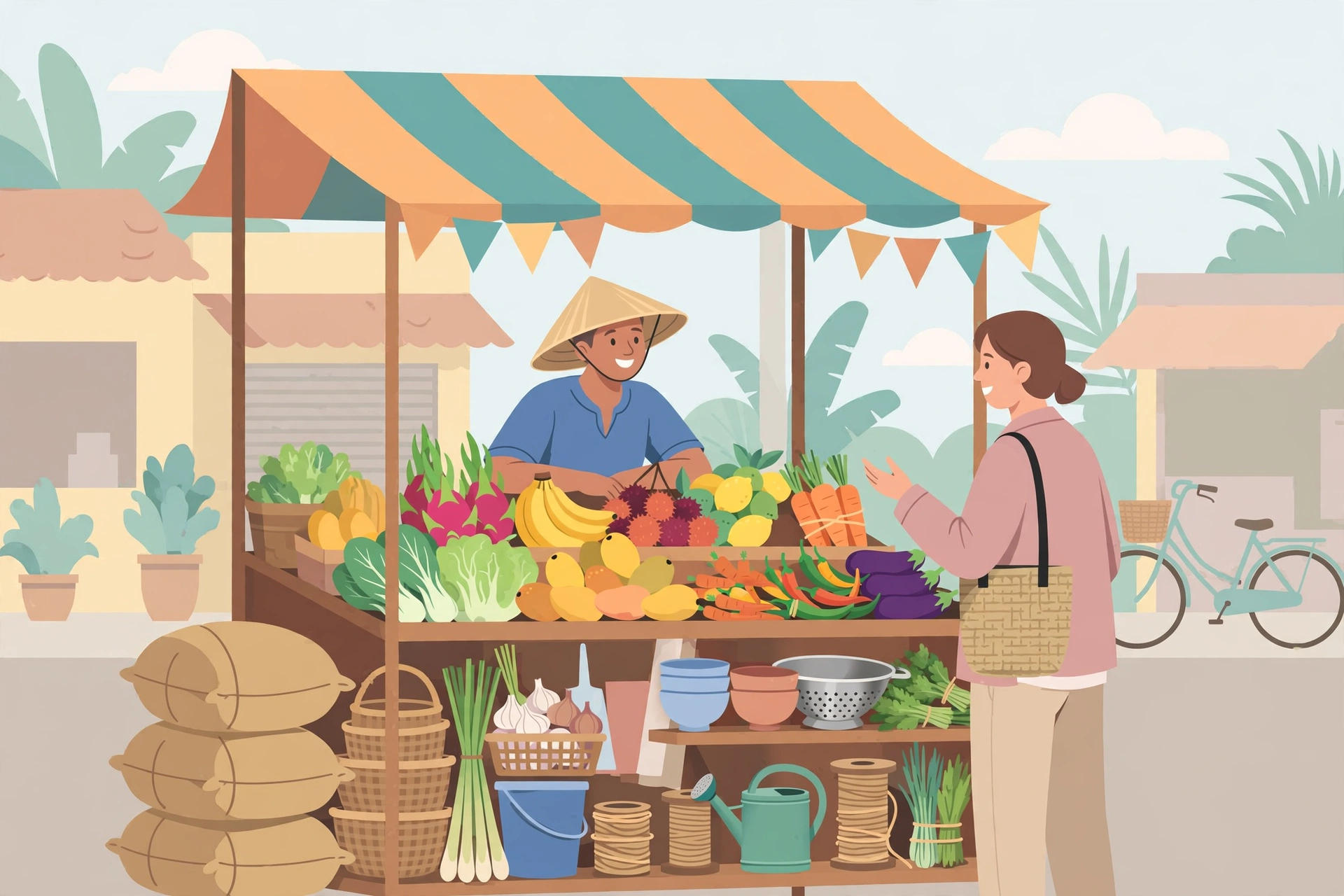
The things you meet every day in Vietnam: home, school, the market, money, food and the street itself.
| # | Vietnamese | Meaning | Type (Telex) |
|---|---|---|---|
| 38 | nhà | house; home | nhaf |
| 39 | trường | school | truowngf |
| 40 | lớp | class | lowps |
| 41 | cơm | rice; a meal | cowm |
| 42 | phở | phở (noodle soup) | phowr |
| 43 | xe | vehicle; bike; car | xe |
| 44 | đường | road, street; sugar | dduwowngf |
| 45 | phố | street (in a town) | phoos |
| 46 | chợ | market | chowj |
| 47 | tiền | money | tieenf |
| 48 | nước | water; country | nuowsc |
| 49 | sách | book | sachs |
| 50 | bàn | table | banf |
| 51 | ghế | chair | ghees |
| 52 | cửa | door | cuwar |
| 53 | áo | shirt; top | aos |
| 54 | quần | trousers | quaanf |
| 55 | giày | shoes | giayf |
| 56 | tóc | hair | tocs |
4. Describing words (12 words)
Twelve adjectives that describe almost anything: good, big, new, fast, many — and their opposites.
| # | Vietnamese | Meaning | Type (Telex) |
|---|---|---|---|
| 57 | tốt | good | toots |
| 58 | đẹp | beautiful | ddepj |
| 59 | lớn | big | lowns |
| 60 | nhỏ | small | nhor |
| 61 | mới | new | mowis |
| 62 | cũ | old (of things) | cux |
| 63 | nhanh | fast | nhanh |
| 64 | chậm | slow | chaamj |
| 65 | nhiều | many; much | nhieeuf |
| 66 | ít | few; little | its |
| 67 | vui | happy; fun | vui |
| 68 | buồn | sad; bored | buoonf |
5. Little words that hold sentences together (20 words)
These are the words learners usually skip — and the ones that make sentences work. Và joins things, của shows possession, trong and trên place things, nếu and vì build reasons and conditions.
| # | Vietnamese | Meaning | Type (Telex) |
|---|---|---|---|
| 69 | và | and | vaf |
| 70 | của | of; belonging to | cuar |
| 71 | trong | in; inside | trong |
| 72 | trên | on; above | treen |
| 73 | ở | at; in (a place) | owr |
| 74 | với | with | vowis |
| 75 | để | to; in order to | ddeer |
| 76 | thì | then (topic marker) | thif |
| 77 | mà | but; that (relative) | maf |
| 78 | khi | when | khi |
| 79 | nếu | if | neesu |
| 80 | vì | because | vif |
| 81 | nhưng | but | nhuwng |
| 82 | hay | or; good, interesting | hay |
| 83 | sao | why; how; star | sao |
| 84 | gì | what | gif |
| 85 | nào | which | naof |
| 86 | đâu | where | ddaau |
| 87 | bao | how many (in “bao nhiêu”) | bao |
| 88 | thế | so; like that | thees |
6. Time words (12 words)
The last group places everything in time — the same words our guide to days, months and telling the time builds into full dates.
| # | Vietnamese | Meaning | Type (Telex) |
|---|---|---|---|
| 89 | ngày | day | ngayf |
| 90 | tháng | month | thangs |
| 91 | năm | year | nawm |
| 92 | giờ | hour; o’clock | giowf |
| 93 | thứ | day of the week; order | thuws |
| 94 | hôm | day (in “hôm nay”, “hôm qua”) | hoom |
| 95 | nay | this; now (in “hôm nay”) | nay |
| 96 | mai | tomorrow (in “ngày mai”) | mai |
| 97 | qua | past (in “hôm qua”) | qua |
| 98 | rồi | already | rooif |
| 99 | luôn | always | luoon |
| 100 | vẫn | still | vaanx |
A 10-sentence typing drill
Each sentence below uses only words from the list above. Read it out loud, then type it in Telex. If every word on your screen matches the sentence here, you know the words — and you can type them.
- Tôi tên là Lan. — My name is Lan. — Type: Tooi teen laf Lan.
- Bạn khỏe không? — How are you? — Type: Banj khoer khoong?
- Tôi muốn một ly cà phê. — I would like a coffee. — Type: Tooi muoosn mootj ly caf phee.
- Hôm nay là thứ Bảy. — Today is Saturday. — Type: Hoom nay laf thuws Bayr.
- Cảm ơn bạn. — Thank you. — Type: Camr own banj.
- Tôi học tiếng Việt. — I am learning Vietnamese. — Type: Tooi hojc tieesng Vieetj.
- Nhà tôi ở Hà Nội. — My home is in Hanoi. — Type: Nhaf tooi owr Haf Nooji.
- Tôi đi chợ mua cơm. — I am going to the market to buy rice. — Type: Tooi ddi chowj mua cowm.
- Bây giờ là chín giờ sáng. — Now it is nine in the morning. — Type: Baay giowf laf chins giowf sangs.
- Tôi rất thích phở. — I really like phở. — Type: Tooi raats thichs phowr.
When the ten sentences feel easy, make your own: swap Lan for your name, Hà Nội for your city, phở for your favourite food. The 100 words above are enough to say who you are, what you want and what you like — which is most of what a first conversation needs.
Key takeaways
- Learn the 100 words in groups of ten a day — people first, then verbs, then things, then descriptions, then little words, then time.
- Pronouns are family words: tôi, bạn, anh, chị, em, mình and the kinship words cô, chú, bác, ông, bà do the work of “I” and “you”.
- The twenty verbs in group 2 — là, có, đi, đến, về, làm, nói, biết, muốn, cần and the rest — build most beginner sentences.
- Watch the double meanings: đường is road and sugar, nước is water and country, hay is “or” and “good”.
- Type every word as you learn it: the Telex keystrokes in the tables are the spelling test, and the ten-sentence drill at the end puts the words together.
Frequently asked questions
Are these really the 100 most common Vietnamese words?
They are the 100 words a beginner meets first and uses most: the core pronouns, the everyday verbs, the nouns of daily life, the common adjectives, the connecting words and the time words. Frequency lists disagree on the exact order, and spoken Vietnamese leans even harder on pronouns than written Vietnamese does — but any list of the most-used words in Vietnamese will contain almost all of these.
How long does it take to learn 100 Vietnamese words?
Ten words a day, with typing practice, takes ten days — and the words stick better if you use them in sentences straight away. The ten-sentence drill above uses only words from this list; once you can type all ten sentences without looking, the words are yours.
Why do some words have two meanings, like “đường” (road/sugar)?
Because Vietnamese has a small sound inventory, so one spelling often carries several meanings — context does the work. Đường in a sentence about traffic is a road; in a sentence about coffee, it is sugar. You will rarely confuse them in real life, because the sentence always tells you which one it is.
What is the difference between “cha” and “bố”?
Both mean “father”. Bố is the everyday word — what children call their dad. Cha is formal and literary — you will see it in writing, in old sayings and in the phrase cha mẹ (parents), but you will rarely hear a child call their father cha in daily life.
How do I say “I” in Vietnamese — “tôi”, “mình” or “em”?
It depends on who you are talking to. Tôi is the safe neutral “I” for formal situations and strangers. Mình is the intimate “I” for close friends and family. Em is the “I” you use when talking to someone older than you. Our guide to Vietnamese pronouns explains the whole system with examples.
Ready to practise? Open our free typing trainer and type the ten sentences from the drill above — then take the Vietnamese typing speed test and see how many of the 100 words your fingers already know.
Turn practice into play
You just studied — now lock it in with ten free Vietnamese games: Daily Sprint, Tone Pop, Proverb Puzzle, Café Rush and more. Two minutes a game, and every one builds your typing streak.
Play Vietnamese Games