
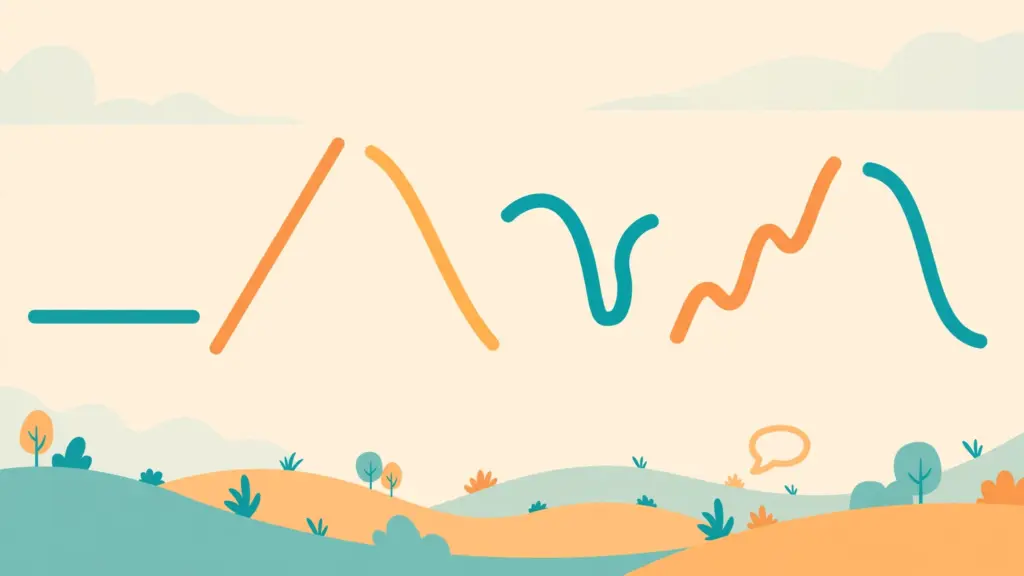
Here is a small surprise for every new learner of Vietnamese: the six words ma, má, mà, mả, mã, mạ are six different words. They are spelled with the same letters. The only difference is the small mark above or below the “a” — and that mark changes the meaning completely, from a ghost to a mother to a tomb.
That is because Vietnamese is a tonal language: the pitch of your voice — up, down, or flat — is part of every word, just like the letters. Get the pitch wrong and you have said a different word; get it right, and people understand you far more easily.
This guide explains all six tones in plain English: what each one sounds like, its mark, the Telex key used to type it, and example words from daily life. When you are ready, our free typing trainer teaches the tones one at a time, so your ears and fingers learn together.
The 6 tones at a glance
Standard Vietnamese has six tones. Five are written with a mark; the level tone has no mark at all. The famous “ma” family shows all six side by side:
| Tone | On “ma” | How the pitch moves | Meaning | Telex key |
|---|---|---|---|---|
| ngang (level) | ma | Flat and steady, at a natural middle pitch. | a ghost | — (none) |
| sắc (sharp) | má | Rises up, like your voice at the end of “Really?” | mother (common in the South); also cheek | s |
| huyền (deep) | mà | Falls down gently and relaxes, like a soft sigh. | but; which / that | f |
| hỏi (asking) | mả | Dips down, then lifts a little — a small hook. | a tomb, a grave | r |
| ngã (tumbling) | mã | Rises with a break or squeeze in the middle — a wavy rise. | a code (as in mã số, code number); also appearance | x |
| nặng (heavy) | mạ | Low, short, heavy. Drops down and stops quickly. | a rice seedling; also to plate (metal) | j |
Do not try to master all six in one day. Meet each tone properly below, one at a time.
Tone 1: Ngang — the level tone (no mark, no key)
The ngang tone is flat. Your voice holds one steady, natural pitch, like holding a single note on a piano. It is the “default” tone: a syllable with no mark is ngang. Because it has no mark, it has no Telex key either — you simply type the plain letters.
- ba — three (also “father” in the South)
- hoa — a flower
- đi — to go
The real skill is keeping your voice truly flat — not letting it rise at the end the way English voices often do.
Tone 2: Sắc — the rising tone (Telex key: s)
The sắc tone rises. Start at a normal pitch and push your voice upward, as at the end of “Are you sure?” Its mark is a small line leaning up to the right: á. In Telex, press s at the end of the syllable: mas → má.
- cá — a fish
- lá — a leaf
- bán — to sell (remember this word — it returns below)
Tone 3: Huyền — the falling tone (Telex key: f)
The huyền tone falls. Your voice starts around the middle and sinks slowly, low and relaxed. Its mark leans down to the right: à. In Telex, press f at the end of the syllable: maf → mà.
- nhà — a house, a home
- gà — a chicken
- bàn — a table
Sắc and huyền form a rising/falling pair. Practising them together — má, mà, má, mà — is one of the fastest ways to train your ear.
Tone 4: Hỏi — the asking tone (Telex key: r)
The hỏi tone dips: your voice goes down first, then rises a little at the end, making a small hook — and its mark looks like a tiny hook too: ả. The name hỏi means “to ask”, a handy way to remember it. In Telex, press r at the end of the syllable: mar → mả. The word “hỏi” itself carries this tone.
- hỏi — to ask
- đỏ — red (the colour)
- của — of, belonging to
Tone 5: Ngã — the tumbling tone (Telex key: x)
The ngã tone is the wavy one. Your voice rises, but with a small break or tight squeeze in the throat in the middle, then continues up. Its mark is a little wave: ã. For many learners this is the hardest tone to hear and to say, so give it extra time. In Telex, press x at the end of the syllable: max → mã. Fittingly, the verb “ngã” — to fall — carries this tone itself.
- ngã — to fall, to fall over
- sữa — milk
- mã số — a code number
Tone 6: Nặng — the heavy tone (Telex key: j)
The nặng tone is low, short, and heavy — its name literally means “heavy”. Your voice drops low and stops quickly, cut off short, like setting a heavy bag on the floor: done. Its mark is a dot under the vowel: ạ — the only tone mark that goes below the letter. In Telex, press j at the end of the syllable: maj → mạ.
- học — to study, to learn
- một — one (the number)
- đẹp — beautiful
A good test: the word should feel short. If your “mạ” lasts as long as your “ma”, it is not heavy enough yet.
Why tones matter so much
In English, pitch changes the feeling of a sentence — surprise, doubt, excitement. In Vietnamese, pitch changes the dictionary meaning of the word. Small mark, completely different word:
- bán (rising) means “to sell”; bàn (falling) means “a table”. Use the wrong one in a shop and your sentence stops making sense.
- dưa (level) is a melon; dừa (falling) is a coconut. Both are delicious — only one is the one you asked for.
- mua (level) means “to buy”; mùa (falling) means “a season”. One small mark separates shopping from the weather.
This is no reason to fear speaking: listeners are used to learners, context usually saves the sentence, and people are kind about tone mistakes. But do learn the tones from the very beginning, not “later” — a word learned with the wrong tone must be re-learned, while one learned right is yours for good. In writing there is no excuse at all: the correct mark is one Telex key away.
How to learn the tones
Tones are a listening skill and a speaking skill at the same time. This simple routine works well:
- Learn the shapes, not just the names. Picture each tone as a line — flat, up, down, hook, wave, drop — and when you hear a word, trace its line in the air with your finger. It sounds silly; it works.
- Listen and repeat in pairs. Word pairs like bán / bàn and mua / mùa train your ear to hear the one thing that changes. Say them slowly, then at normal speed.
- Record yourself. Record the six “ma” words on your phone, listen back, and compare with the table above — ears improve quickly once you can hear your own mistakes.
- Learn every new word with its tone. Write the mark, say the tone’s name, and say the word out loud — all three, every time.
- Type the tones, too. Typing forces a decision on every syllable: which tone is this? Repeated hundreds of times, that decision builds tone awareness faster than reading alone.
That is exactly how our typing lessons are organised: plain level-tone syllables first, then one tone at a time — sắc, huyền, hỏi, ngã, nặng — so you always practise the new tone against ones you already know. Short lessons, instant feedback, no sign-up.
Frequently asked questions
How many tones does Vietnamese have?
Six, in the standard system taught to learners: ngang (level), sắc (rising), huyền (falling), hỏi (dipping), ngã (tumbling), and nặng (heavy). Five are written with a mark; the level tone has no mark.
Are the tones the same in the North and the South?
Almost. The six-tone system here is the standard system, clearly heard in Northern speech, for example in Hanoi. In Southern speech, for example in Ho Chi Minh City, hỏi and ngã often merge in everyday pronunciation and sound the same. But spelling keeps both marks, because they show different words — so learn all six for reading, writing, and typing.
Which tone should I learn first?
Start with the pair sắc (rising) and huyền (falling) — they are the easiest to hear as opposites. Then add hỏi and ngã, the two “curved” tones, and finish with nặng, the short heavy one. That is the order in our free Telex lessons, and it works well for self-study too: one tone at a time, always compared with what you already know.