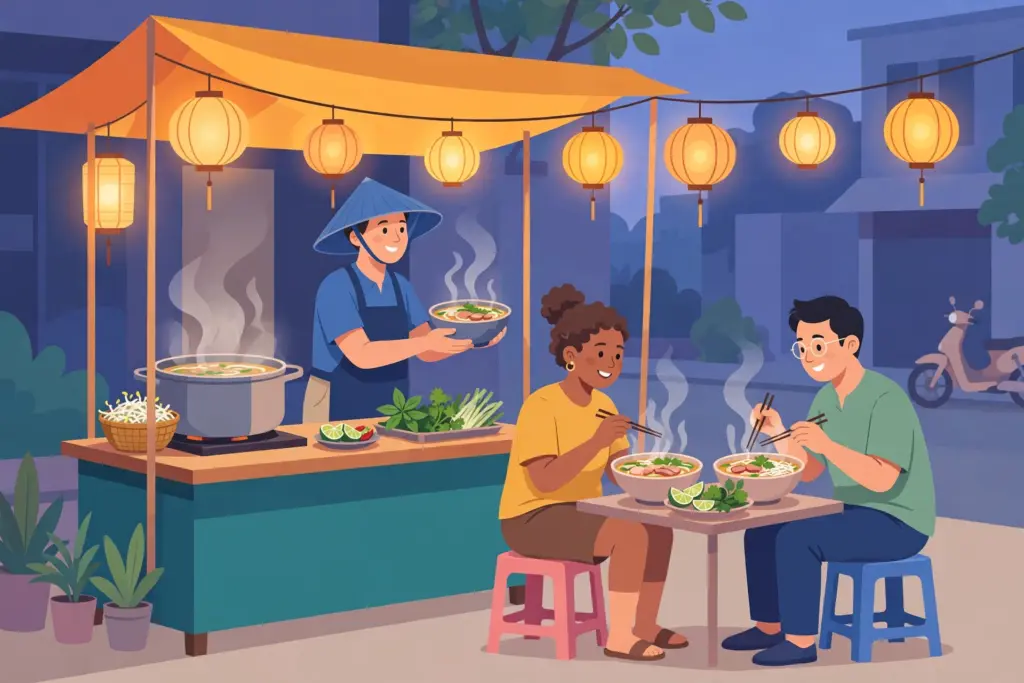
Ordering Food in Vietnamese: 25 Phrases for Restaurants and Street Stalls
Food is where Vietnamese pays off fastest. A coffee seller who hears Cho tôi một ly cà phê instead of a pointed finger hears respect in one sentence — and the food tastes better for it. The good news is that ordering is the easiest conversation in the language: one pattern orders almost anything.
This guide gives you 25 phrases for the whole meal — getting seated, ordering, adjusting the taste, handling allergies, and paying — with the correct spelling and Telex keystrokes for every one. If Telex is new, our complete Telex guide explains the keys; if you need the numbers for prices, our guide to Vietnamese numbers covers 1 to 1,000. And if you have not met the pronouns yet, read our guide to Vietnamese pronouns — a well-placed anh or chị makes every phrase in this guide warmer.
The one pattern that orders anything: “Cho tôi một…”
Almost every order in Vietnamese starts the same way: Cho tôi một… — “Give me one…” (type: Cho tooi mootj…). Put any dish after it and you have ordered:
🎮 Play Vietnamese Games — free
- Cho tôi một phở bò. — One beef phở, please. Type: Cho tooi mootj phowr bof.
- Cho tôi một bánh mì. — One bánh mì, please. Type: Cho tooi mootj bansh mif.
- Cho tôi một ly cà phê. — One coffee, please. Type: Cho tooi mootj ly caf phee.
- Cho tôi một chai nước. — One bottle of water, please. Type: Cho tooi mootj chai nuwowcs.
Change the number and you order for the table: Cho tôi hai phở bò (“Two beef phở, please” — type: Cho tooi hai phowr bof), Cho tôi ba ly trà đá (“Three iced teas, please” — type: Cho tooi ba ly traf ddas). The pattern never changes; only the dish and the number change. Add làm ơn (“please” — type: lafm own) at the end whenever you want to be extra polite.
At a street stall there is often no menu at all — just pots, a grill, and a queue. The pattern still works: point, say Cho tôi một…, and add the name of the dish if you know it. If you do not know it, Cái này (“This one” — type: Casi nafy) with a point does the job.
Getting seated and reading the menu
These five phrases cover the arrival:
| # | Vietnamese | English | Type (Telex) |
|---|---|---|---|
| 1 | Cho tôi xem thực đơn. | Can I see the menu? | Cho tooi xem thuwcj ddown. |
| 2 | Tôi muốn một bàn cho hai người. | I’d like a table for two. | Tooi muoosn mootj banf cho hai nguowif. |
| 3 | Có bàn trống không? | Is there a free table? | Cos banf troongs khoong? |
| 4 | Tôi ăn chay. | I’m vegetarian. | Tooi awn chay. |
| 5 | Có món chay không? | Do you have vegetarian dishes? | Cos mons chay khoong? |
A note on phrase 4: ăn chay means eating vegetarian, and it is widely understood — Vietnam has a large Buddhist tradition and a whole vegetarian cuisine. Say it when you sit down, not when the food arrives: the kitchen can adjust, but only if it knows in time.
Menus in tourist areas often have English, but the Vietnamese side is usually more complete. If the menu is Vietnamese-only, look for the words you know: phở (noodle soup), cơm (rice), bún (vermicelli), gà (chicken), bò (beef), cá (fish). Recognising six words is often enough to order well.
Ordering: dishes worth knowing by name
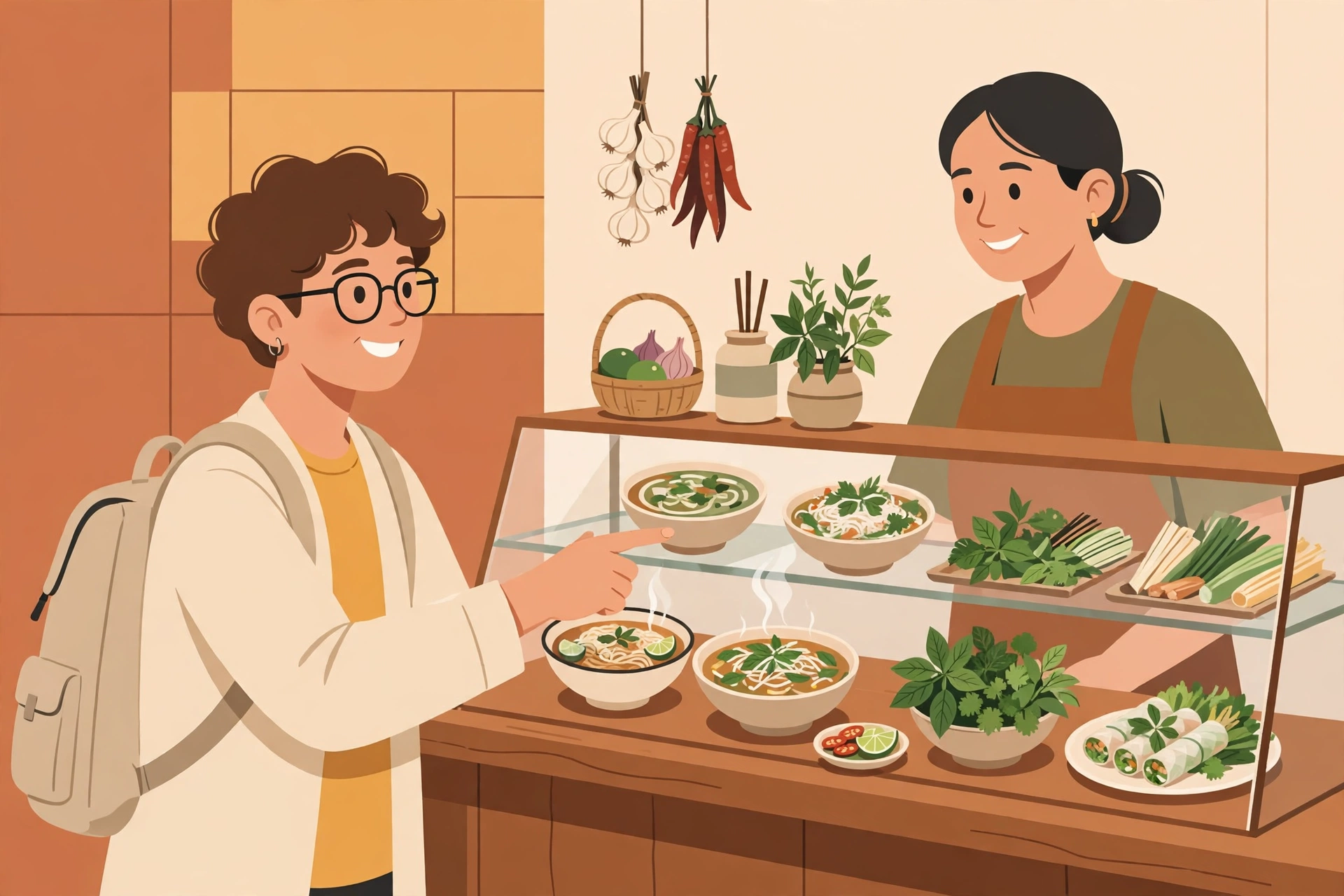
Once you have the pattern, the dish names do the work. These eight phrases order the classics:
| # | Vietnamese | English | Type (Telex) |
|---|---|---|---|
| 6 | Cho tôi một phở bò. | One beef phở, please. | Cho tooi mootj phowr bof. |
| 7 | Cho tôi một bánh mì. | One bánh mì, please. | Cho tooi mootj bansh mif. |
| 8 | Cho tôi một ly cà phê. | One coffee, please. | Cho tooi mootj ly caf phee. |
| 9 | Cho tôi một chai nước. | One bottle of water, please. | Cho tooi mootj chai nuwowcs. |
| 10 | Tôi muốn gọi món. | I’d like to order. (literally “I want to call dishes”) | Tooi muoosn goij mons. |
| 11 | Cho tôi thêm một ly nữa. | One more glass, please. | Cho tooi theem mootj ly nuwax. |
| 12 | Ăn ở đây. | Eating here / dine in. | Awn owr ddaay. |
| 13 | Tôi muốn mang về. | I’d like takeaway. | Tooi muoosn mang veef. |
Phrase 10 is the one to use when you are ready: Tôi muốn gọi món — “I’d like to order” — then your dishes, one by one. Phrases 12 and 13 answer the question every takeaway stall asks: “Ăn ở đây hay mang về?” (“Eat here or take away?”).
More dishes for the same pattern: phở gà (chicken phở — type phowr gaf), cơm tấm (broken rice — type cowm taasm), bún chả (grilled pork with vermicelli — type buns char), gỏi cuốn (fresh spring rolls — type goir cuoosn), trà đá (iced tea — type traf ddas).
Taste, spice and adjustments
Vietnamese food is seasoned at the table as much as in the kitchen. These six phrases get it exactly how you want it:
| # | Vietnamese | English | Type (Telex) |
|---|---|---|---|
| 14 | Món này ngon quá! | This dish is delicious! | Mons nafy ngon quas! |
| 15 | Không cay, làm ơn. | Not spicy, please. | Khoong cay, lafm own. |
| 16 | Cay một chút thôi. | Just a little spicy. | Cay mootj chust thooi. |
| 17 | Không đá, làm ơn. | No ice, please. | Khoong ddas, lafm own. |
| 18 | Cho tôi xin đũa và thìa. | Could I have chopsticks and a spoon? | Cho tooi xin dduax vaf thiaf. |
| 19 | Tôi bị dị ứng với đậu phộng. | I’m allergic to peanuts. | Tooi bij dij uwsng vowis ddaauj phoongj. |
Phrase 15 is the most useful sentence in this whole guide. Vietnamese “not spicy” is often still spicy by foreign standards, so say it clearly when you order — and if you want heat, phrase 16 (một chút thôi, “just a little”) is the safe way to ask for it: you can always add more chilli from the table, but you cannot take it out of the soup.
Phrase 19 deserves a warning: đậu phộng (peanuts) appear in many dishes as a topping or a garnish you cannot see. Say the allergy sentence when you sit down, and double-check when the dish arrives — “Có đậu phộng không?” (“Does it have peanuts?” — type: Cos ddaauj phoongj khoong?). Swap in your own allergen the same way: Tôi bị dị ứng với… plus tôm (shrimp — toom), trứng (egg — truwsng), or sữa (milk — suwax).
Paying and leaving
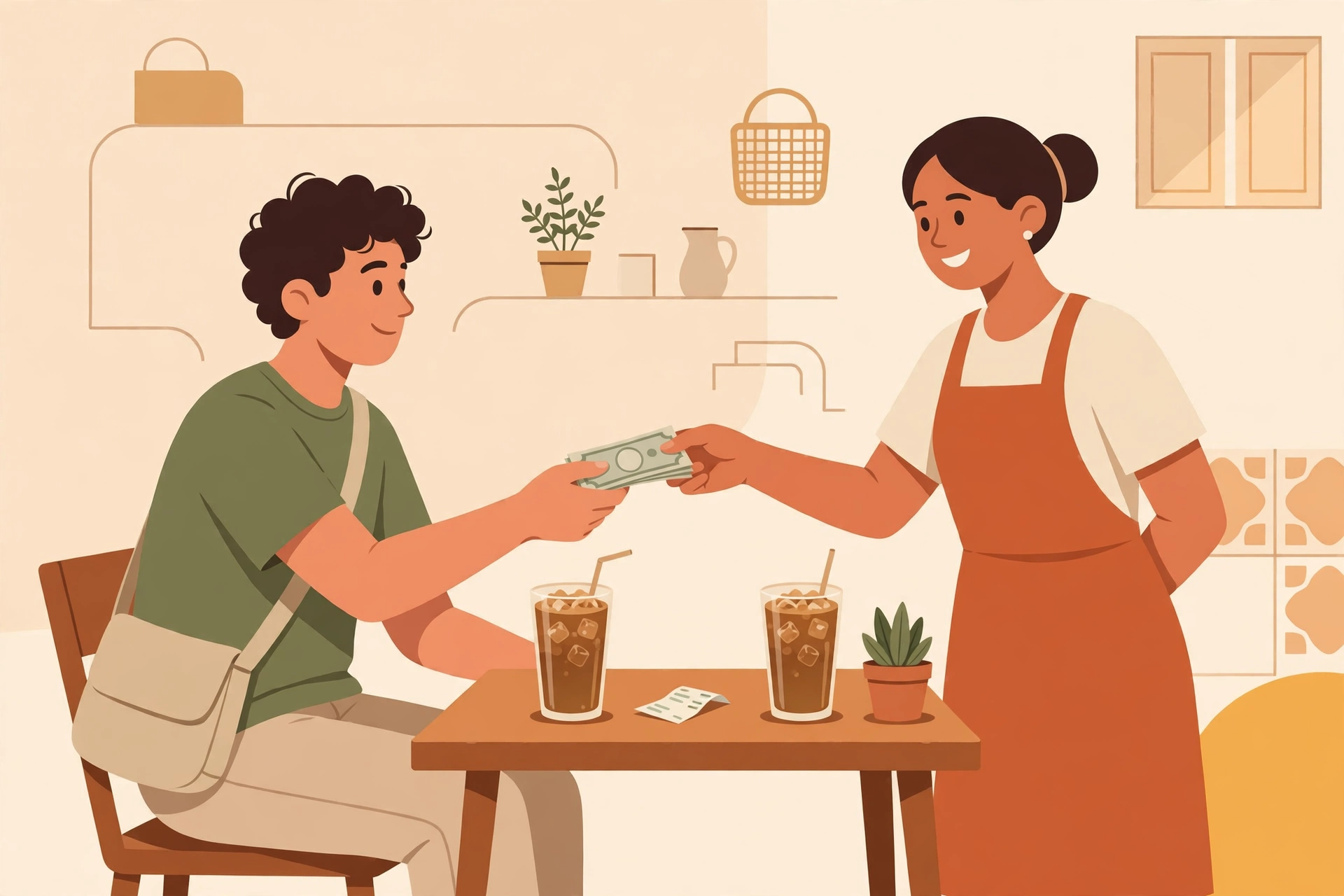
The meal ends the same way in almost every Vietnamese restaurant: you ask for the bill, you hear the price, you pay. Tipping is not expected.
| # | Vietnamese | English | Type (Telex) |
|---|---|---|---|
| 20 | Có Wi-Fi không? | Do you have Wi-Fi? | Cos Wi-Fi khoong? |
| 21 | Tính tiền, làm ơn. | The bill, please. | Tinhs tieenf, lafm own. |
| 22 | Bao nhiêu tiền? | How much is it? | Bao nhieeuf tieenf? |
| 23 | Tôi muốn thanh toán bằng thẻ. | I’d like to pay by card. | Tooi muoosn thanh toans bawngf ther. |
| 24 | Nhà vệ sinh ở đâu? | Where is the toilet? | Nhaf veej sinh owr ddaau? |
| 25 | Cảm ơn, món ăn rất ngon. | Thank you, the food was delicious. | Camr own, mons awn raats ngon. |
Phrase 21, Tính tiền, is the one to memorise: say it, catch the waiter’s eye, and the bill comes. The price will usually be spoken in thousands of đồng — a 45,000-đồng bowl of phở is quoted as bốn mươi lăm nghìn (“forty-five thousand” — type: boons muowi lawm nghifn), or just bốn mươi lăm with the nghìn dropped.
Card payment (phrase 23) works in most sit-down restaurants and cafés in the cities, but street stalls are cash-only — carry small notes.
How to pronounce the tricky ones
Three sounds trip up almost every learner in a restaurant. The first is phở: one syllable, roughly “fuh” with a rising-and-falling tone — not “foe”, not “faux”. The second is cơm vs cám: cơm (cooked rice) has the ơ vowel, cám (bran) has ă. The third is the tone on món (dish, rising tone) vs mòn (worn out, falling tone).
The fix for all three is the same: say the word slowly, exaggerate the tone, and listen to the reply — Vietnamese speakers will repeat the word back to you correctly, and that repetition is free pronunciation coaching. Our guide to the six Vietnamese tones explains each tone with examples.
A 10-phrase typing drill
Type each phrase in Telex, then read it out loud. Every keystroke below has been checked against our typing engine — and these are the ten phrases you will actually use at your next meal.
- Cho tôi xem thực đơn. — Can I see the menu? Type: Cho tooi xem thuwcj ddown.
- Cho tôi một phở bò. — One beef phở, please. Type: Cho tooi mootj phowr bof.
- Cho tôi một ly cà phê. — One coffee, please. Type: Cho tooi mootj ly caf phee.
- Tôi ăn chay. — I’m vegetarian. Type: Tooi awn chay.
- Không cay, làm ơn. — Not spicy, please. Type: Khoong cay, lafm own.
- Món này ngon quá! — This dish is delicious! Type: Mons nafy ngon quas!
- Cho tôi thêm một ly nữa. — One more glass, please. Type: Cho tooi theem mootj ly nuwax.
- Tính tiền, làm ơn. — The bill, please. Type: Tinhs tieenf, lafm own.
- Bao nhiêu tiền? — How much is it? Type: Bao nhieeuf tieenf?
- Cảm ơn, món ăn rất ngon. — Thank you, the food was delicious. Type: Camr own, mons awn raats ngon.
When these ten feel easy, try our 30 essential Vietnamese phrases — and play Wordfall on our practice page, where the new Ordering Food pack has all the taste words from this guide.
Key takeaways
- One pattern orders almost anything: Cho tôi một… + dish + number.
- Say Tôi ăn chay and any allergy sentence (Tôi bị dị ứng với…) when you sit down, not when the food arrives.
- Không cay, làm ơn is the most useful sentence in the guide.
- End the meal with Tính tiền, làm ơn; prices are quoted in thousands of đồng — bốn mươi lăm means 45,000đ.
- Street stalls are cash-only with small notes; sit-down restaurants in the cities usually take cards — ask with Tôi muốn thanh toán bằng thẻ.
Frequently asked questions
How do I order food in Vietnamese?
Say Cho tôi một… (“Give me one…”) followed by the dish: Cho tôi một phở bò (one beef phở), Cho tôi một bánh mì (one bánh mì). Change the number for more: Cho tôi hai phở bò orders two.
How do I say “I’m vegetarian” in Vietnamese?
Tôi ăn chay. — type: Tooi awn chay. Say it when you sit down so the kitchen knows in time.
How do I ask for the bill in Vietnamese?
Tính tiền, làm ơn. — “The bill, please”, type: Tinhs tieenf, lafm own. The price is spoken in thousands of đồng, so 45,000đ is quoted as bốn mươi lăm nghìn — or just bốn mươi lăm.
Do Vietnamese restaurants take credit cards?
Sit-down restaurants and cafés in the cities usually do — ask with Tôi muốn thanh toán bằng thẻ (“I’d like to pay by card”). Street stalls are cash-only, so carry small notes: a 500,000đ note at a 25,000đ stall means a long search for change.
What does “phở bò” mean, and how do I pronounce “phở”?
Phở bò is beef phở — phở is the noodle soup, bò is beef. Pronounce phở as one syllable, roughly “fuh” with a rising-and-falling tone — not “foe” and not “faux”.
Ready to practise? Open our free typing trainer and type the ten-phrase drill until the orders come without thinking — then take the Vietnamese typing speed test and see how fast your dinner orders have become.
Turn practice into play
You just studied — now lock it in with ten free Vietnamese games: Daily Sprint, Tone Pop, Proverb Puzzle, Café Rush and more. Two minutes a game, and every one builds your typing streak.
Play Vietnamese Games