Telex vs VNI: Which Input Method Should You Learn?
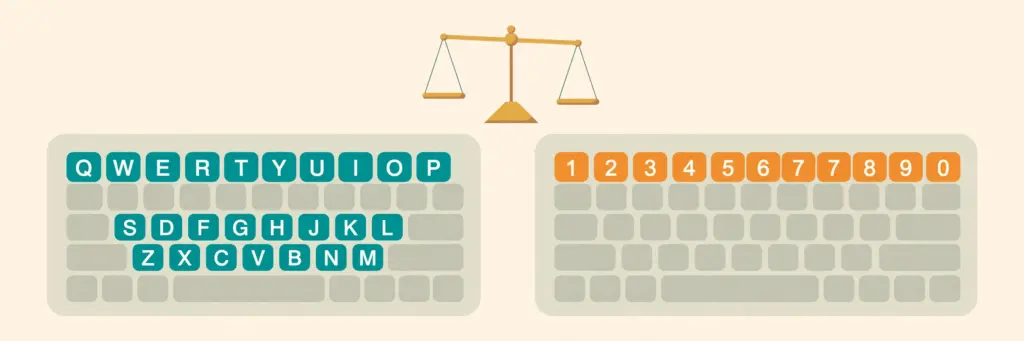
You want to type Vietnamese, and every guide points you to two names: Telex and VNI. Both turn an ordinary keyboard into a Vietnamese keyboard. Both produce exactly the same finished words — your readers can never tell which one you used. The only difference is which keys you press to get there: letters for Telex, numbers for VNI.
This guide puts them side by side — same words, both keystroke sets, honest trade-offs — so you can choose once and stop second-guessing. If either method is completely new to you, start with our complete Telex guide and our complete VNI guide; this comparison assumes you know the basic idea of both.
The two systems in one table
Here is the whole difference, compressed. Everything else in this article is commentary on this table:
| What you want | Telex (letters) | VNI (numbers) |
|---|---|---|
| Rising tone (sắc) | s | 1 |
| Falling tone (huyền) | f | 2 |
| Asking tone (hỏi) | r | 3 |
| Tumbling tone (ngã) | x | 4 |
| Heavy tone (nặng) | j | 5 |
| Circumflex: â, ê, ô | double the vowel: aa, ee, oo | 6 |
| Horn: ơ, ư | w after o or u | 7 |
| Breve: ă | w after a | 8 |
| Crossed d: đ | dd | d9 |
| Erase a mark | z | 0 |
Notice the pattern: Telex reuses letters that Vietnamese spelling never needs in those positions, so its keys sit right where your fingers already are. VNI uses a separate row of keys, so its marks can never be mistaken for letters — at the cost of a longer finger journey.
Same words, both methods
The fastest way to feel the difference is to type the same words twice. Cover one column, type the word, then check the other column:
| Vietnamese | Meaning | Telex | VNI |
|---|---|---|---|
| chào | hello | chaof | cha2o |
| cảm ơn | thank you | Camr own | Ca3m o7n |
| Việt Nam | Vietnam | Vieetj Nam | Vie65t Nam |
| tiếng Việt | Vietnamese language | tieesng Vieetj | tie61ng Vie65t |
| phở | noodle soup | phowr | pho73 |
| xương | bone | xuwowng | xuong7 |
| được | to get; OK; allowed | dduwowcj | — (see note below) |
Two rows deserve a note. xương shows VNI at its cleverest: one press of 7 covers both horned vowels, while Telex needs two w keys. được shows the opposite: Telex handles its two horned vowels plus a tone in one flowing string, while VNI’s handling of two horns plus a tone in one word is fiddly enough that beginners should simply learn it inside real typing software rather than from a table — try it in UniKey and watch what each keypress does.
Now try a full sentence both ways. “Hello, my name is Anna. I am fine, thank you.”
- Telex: Xin chaof, Tooi teen laf Anna. Tooi khore, Camr own.
- VNI: Xin cha2o, To6i te6n la2 Anna. To6i kho3e, Ca3m o7n.
One Telex trap hides in that sentence, so learn it here rather than from an embarrassing message: tôi is tooi — double the o first, then add the i. Beginners often type toio instead, doubling nothing and ending with a stray o, which produces no correct word at all. VNI’s version, To6i, has no such trap — the 6 simply means “put a hat on the o”. Keep that asymmetry in mind for the verdict below.
Speed: Telex wins, but by less than you think
Telex is the faster method for most people, for a simple physical reason: its keys live on the three letter rows, so your fingers barely travel, while VNI sends a finger up to the number row for every single mark — and Vietnamese words carry marks constantly. On a phone the gap grows: the number row is hidden behind an extra tap, so VNI typing on a phone feels like typing with one hand tied.
But the honest size of the gap matters. For a learner typing a few messages a day, the difference is seconds, not minutes. Speed only becomes a real argument at high volume — a Vietnamese office worker typing all day, or a fast chat conversation. If you type Vietnamese for an hour a day or less, choose on comfort, not on speed.
Accuracy and the English problem
Here VNI wins clearly. Telex’s letter keys are also real letters, so Telex can misfire: type an English word like “saw” or “cow” with Telex still on, and the software may helpfully turn it into Vietnamese. Every Telex user has sent a message with a mysteriously accented English word in it. VNI cannot do this — digits are never letters, so your English stays English until you deliberately press a number.
The mirror-image problem belongs to VNI: digits after a vowel become marks, so typing prices, dates and phone numbers needs the input switched off briefly. Telex users never think about numbers at all. So each method has exactly one “wrong neighbourhood” — Telex around English words, VNI around numbers — and your daily life decides which one bites more. Write more English than numbers? Lean VNI. Type more prices and dates than English? Lean Telex.
Learning curve: VNI is calmer, Telex is more powerful
VNI’s rules fit on a postcard: five tones are 1–5, four shapes are 6–9, 0 erases. There are no special cases like “double the vowel, except when…”. A beginner can memorise the whole table in one sitting and spend the rest of the week building speed.
Telex has more to learn: doubled vowels, the w key behaving differently after a, o and u, the ươ combination, and traps like the tôi example above. But that extra learning buys something real: once the keys are automatic, Telex flows without ever leaving the letter rows, and it is the method built into every phone keyboard by default. Most learners who push through the first week never look back.
Availability: Telex is everywhere, VNI lives on Windows
Telex is built into Windows, macOS, iPhone and Android as a standard Vietnamese layout — add the Vietnamese keyboard and you almost certainly get Telex. VNI’s home is Windows with UniKey, the free program generations of Vietnamese computer users have installed first on every new machine. On macOS, VNI is offered in some setups but is not the default; on phones, it is rare. If you switch devices often, Telex is the portable choice. If your Vietnamese life happens on one Windows computer, VNI’s availability gap never appears.
Switching: you are never locked in
The most reassuring fact in this whole comparison: switching costs almost nothing. UniKey on Windows switches between Telex and VNI with a keyboard shortcut, and system keyboards let you pick a layout per device. Many Vietnamese speakers use Telex on their phone and VNI on their computer without thinking about it. So treat this decision as a starting point, not a marriage — pick one, use it for two weeks, and if it itches, switch. Your Vietnamese will survive the move completely intact.
The verdict
| You should learn… | If you… |
|---|---|
| Telex | type mostly on a phone; want the fastest method; switch devices often; or want the method our trainer teaches first. |
| VNI | type mostly on a Windows computer; mix English and Vietnamese in one document; or want the calmest first week of learning. |
If you forced us to pick one default for a new learner, it would be Telex — it is everywhere, it is fastest, and it is what our free typing trainer teaches today, with a VNI practice mode on its way. But a learner who picks VNI for the right reasons — a Windows desk, lots of English in the same documents — has made a perfectly good choice, and the two weeks of practice matter far more than the method. The real mistake is not choosing wrongly. The real mistake is reading comparisons instead of typing.
Key takeaways
- Telex uses letters (s/f/r/x/j for tones, doubled vowels and w for shapes); VNI uses numbers (1–5 for tones, 6–9 for shapes, 0 to erase).
- Telex is faster and available everywhere, especially on phones; VNI is calmer to learn and never corrupts English words.
- Each method has one trap: Telex misfires on English words, VNI misfires on real numbers.
- Switching is free and instant (UniKey shortcut on Windows), so pick one, practise two weeks, and switch if it itches.
- Default pick for a new learner: Telex — but VNI is a fully respectable choice for a Windows-based, English-mixing typist.
Frequently asked questions
Do Telex and VNI produce different-looking Vietnamese?
No. The finished text is identical — chào is chào either way. Only the keystrokes differ, so readers, teachers and employers never know or care which method you used.
Can I use both methods?
Yes, and many people do: Telex on the phone, VNI on the computer, for example. The tone systems are the same in both, so what transfers is your knowledge of Vietnamese itself; only the finger habits are method-specific.
Which method do Vietnamese people actually use?
Both, split roughly by device and generation: Telex dominates on phones and among younger users, while VNI remains strong among Windows computer users who learned with UniKey. Neither is disappearing.
I already know Telex. Is learning VNI worth it?
Only if you have a concrete reason — for instance, a Windows job where you mix English and Vietnamese all day. Otherwise, your practice time is better spent on vocabulary and tones than on a second set of keys for the same words.
Does your typing trainer support both methods?
Today the trainer teaches Telex, and a VNI mode is on its way. The tones, lessons and speed test teach skills that transfer to either method, so start there either way.
Stop comparing, start typing. Open our free typing trainer and work through the first tone lesson now — ten minutes of real typing teaches more than ten comparisons. When you are ready to measure progress, our Vietnamese typing speed test is waiting.